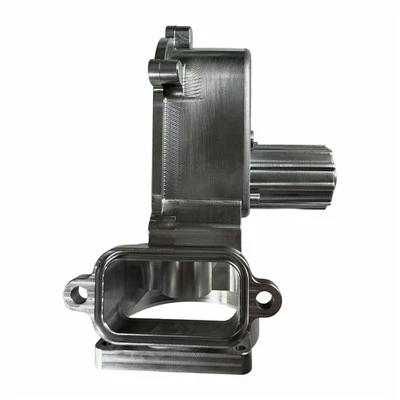

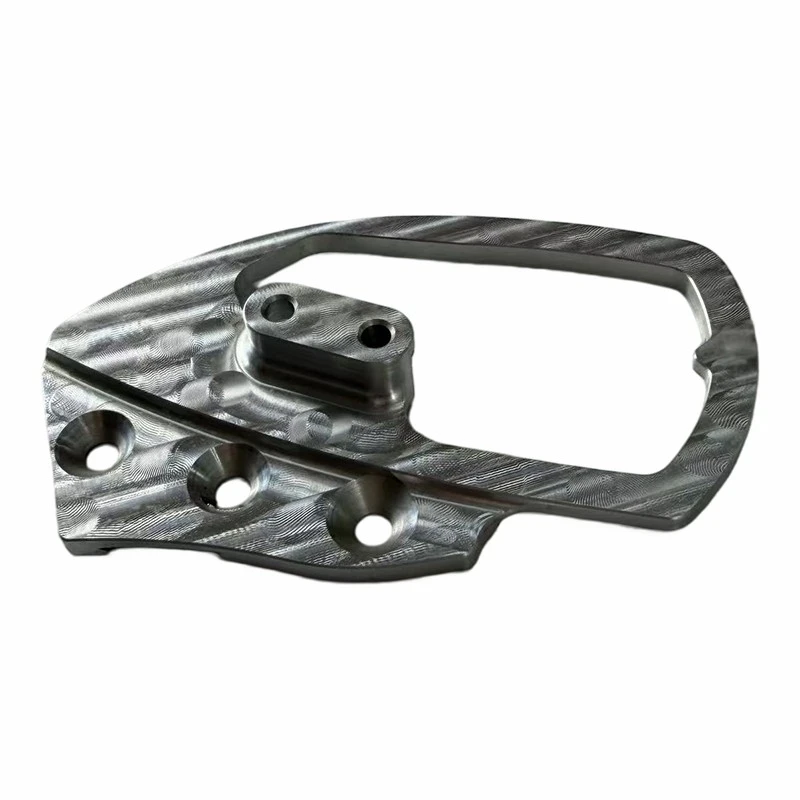


Material and Processing Technology

Substrate
The mainstream is 6061-T6 aviation aluminum alloy, and 7075 aluminum is selected for heavy-duty conditions; Balancing lightweight, machining performance, and structural strength, suitable for power and hydraulic components.

Molding process
The whole is formed by five axis CNC integrated milling, without casting or welding:
The inner and outer cavities, flange installation surfaces, oil passage through holes, positioning protrusions, and heat dissipation ribs are all milled in one go;
The surface retains a clear concentric circular cutting texture, without polishing, only deburring and ultrasonic degreasing are performed;
All hole positions include flange threaded installation holes, locating pin holes, oil passage holes, and sealing sinks, with a tolerance of up to ± 0.02mm;
Internal cavity edge processing sealing groove, used for assembling sealing rings to achieve hydraulic/oil air sealing.

Structural and technological highlights
External vertical heat dissipation rib structure: increases heat dissipation area and reduces internal hydraulic oil/motor working temperature rise;
Irregular composite cavity: divided compartment cavity, separating oil circuit, motor installation position, and valve body assembly area;
Multi directional flange interface: side oil circuit interface, end face installation flange, top sealing flange, to achieve multi pipeline docking;
Fully rounded corners: eliminate stress concentration and avoid cracking under high pressure conditions.
Structural zoning (combined with three views)
1. Right main sealing chamber (first picture)
Large opening sealed compartment, reserved space for motor/valve body assembly, distributed with multiple layers of threaded positioning holes, outer ring annular sealing groove for assembling O-ring, achieving high-pressure sealing.
2. Left oil circuit flange (second picture)
The central large hole is the main oil inlet and outlet of the oil circuit, and the threaded holes on both sides are used for external hydraulic pipelines; The outer vertical heat dissipation ribs are used for internal oil chamber heat dissipation.
3. Installation position of top actuator (third picture)
Polygonal motor cylinder installation column, which accommodates the drive motor inside; The square opening on the side is for wire harness threading, and there are 4 fixing screw holes around it for fixing the motor cover plate.
4. Bottom universal installation flange
Multi foot mounting base with threaded fixing holes, used to secure the entire housing assembly to the frame/equipment base.


Purpose determination
Core positioning: Electric hydraulic actuator housing for automobiles/motorcycles (electronic hydraulic pump valve body assembly)
Segmented application scenarios:
1. Motorcycle modification hydraulic clutch/electronic throttle pump body
Integrated oil chamber, drive motor, and oil passage, replacing the original factory split cast iron pump, lightweight and better heat dissipation, belonging to high-performance modified CNC parts;
2. Automotive electronic brake/steering assist hydraulic valve body housing
Integrated motor, oil circuit, and pressure chamber, serving as the core load-bearing shell for EHB line control and electric power steering;
3. Small scale construction machinery micro hydraulic power unit housing
Micro hydraulic pump station pump body, integrated with motor, oil circuit, and oil storage chamber, used for automation equipment and small agricultural machinery.
Product Advantage Comparison: Original Cast Iron Shell
✅ Reduce weight by 40% to 60% and lower the overall unsprung weight of the vehicle;
✅ Integrated milling has stronger sealing and no risk of sand hole leakage;
✅ The heat dissipation efficiency of the heat dissipation rib structure is better than that of cast iron, and the oil temperature is lower when working for a long time;
✅ The mechanical texture recognition of the modified appearance is high, and it is suitable for the performance modification market;
✅ The structure can be customized, and the cavity volume can be adjusted according to the displacement and oil pressure.
Optional post-processing solutions
1. Natural cleaning (current status): Only removes oil and burrs, retains milling patterns, has the lowest cost, and is suitable for short-term use;
2. Natural anodizing: forming a dense oxide film, rust resistant and wear-resistant, retaining the matte texture of the metal;
3. Hard anodizing: Increases surface hardness to HV400 or above, suitable for high-pressure and wear-resistant working conditions;
4. Black anode+laser marking: The mainstream solution for modified parts is beautiful, rust proof, and can be engraved with model logos.

Supporting Processing Instructions
This type of cavity belongs to complex five axis machining parts, and the machining process flow is as follows:
Aluminum plate cutting → three-axis rough milling to remove excess → five axis linkage precision machining of inner and outer cavities and irregular surfaces → drilling/tapping all threaded holes and pin holes → precision boring of sealing grooves → deburring and high-pressure cleaning → surface treatment (as required) → airtight leak detection (a mandatory inspection process for hydraulic components).
Hot Tags: car modification adapter board, China car modification adapter board manufacturers, suppliers, factory, auto parts, Car Door Cane Handle, Car Seat Foot Adjuster, Engine Stand Brackets, Motor Bearing End Cover, Pressure Injection Housing